
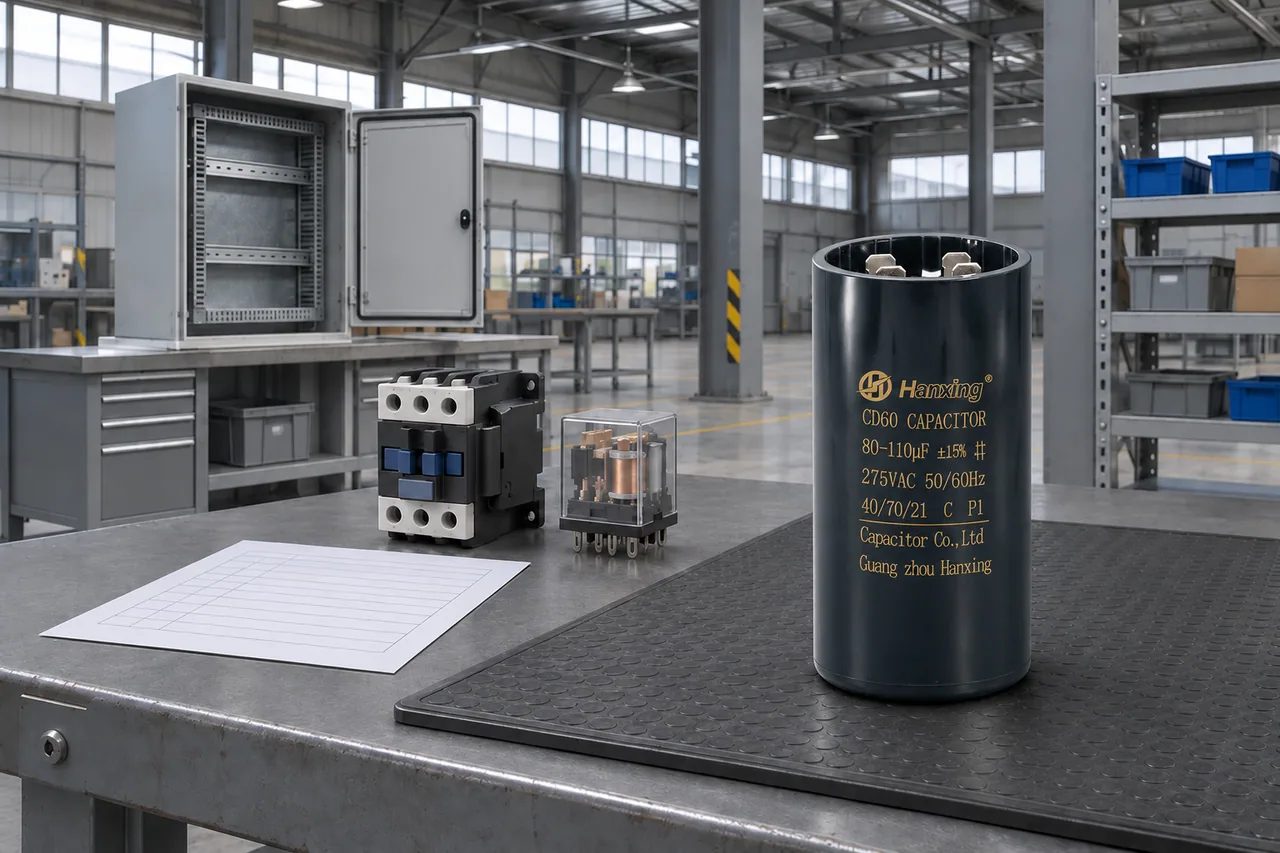
A CD60 is an intermittent-duty AC motor start capacitor. Its permitted on-time and restart interval come from the selected model’s duty rating. Calculate duty cycle as energized time divided by the complete start-to-start cycle, and retain the maximum on-time as a separate limit.
The switching device ends the starting interval
A start capacitor helps the auxiliary winding produce starting torque. The motor’s switching arrangement disconnects it after startup. The relay, switch or other specified device must perform that function; using the right µF value cannot compensate for a start capacitor left connected during continuous running.
For a pump or compressor, describe the longest starting interval under the specified load and the shortest interval before another start. Automatic restart attempts after a fault belong in that description. A nominal starts-per-hour figure can hide a closely spaced group of starts.
500 µF / 300 VAC start-capacitor sample
The visible label gives electrical markings but no on-time or repeat-start limit.
Two sequences with the same percentage
For a calculation example, 2 seconds energized followed by 118 seconds off gives a 120-second cycle. Duty cycle is 2 ÷ 120 × 100 = 1.67%, with 30 evenly spaced starts per hour. A 3-second on-time and 177-second rest also gives 1.67%, but only 20 starts per hour. The second sequence has a longer individual energized interval.
These are arithmetic examples, not HAN XING CD60 ratings or recorded tests. KEMET’s MS/MD datasheet gives a model-specific starting-duty example and shows that voltage and frequency can change the permitted duty. Its limits cannot be transferred to a CD60 by matching the percentage alone. KEMET: MS/MD starting-duty example
- Duty cycle
- 3 ÷ 180 × 100 = 1.67%
- Evenly spaced starts
- 3,600 ÷ 180 = 20 per hour
Specify the worst restart pattern
A motor can take longer to accelerate under a different load. Repeated unsuccessful starts add energized time without bringing the motor to running speed. The equipment protection and switching system must handle that condition. Replacing the capacitor will not repair a failed relay or free a mechanically stalled motor.
Specify the required µF and VAC, frequency, maximum energized time, minimum rest interval and sequence of starts. Use the discharge arrangement required by the motor design, including any specified resistor, as part of the complete circuit.
Specify the CD60 starting pattern
Send the motor circuit, required rating and longest on-time with the shortest restart interval. The model proposal needs to cover that duty.