
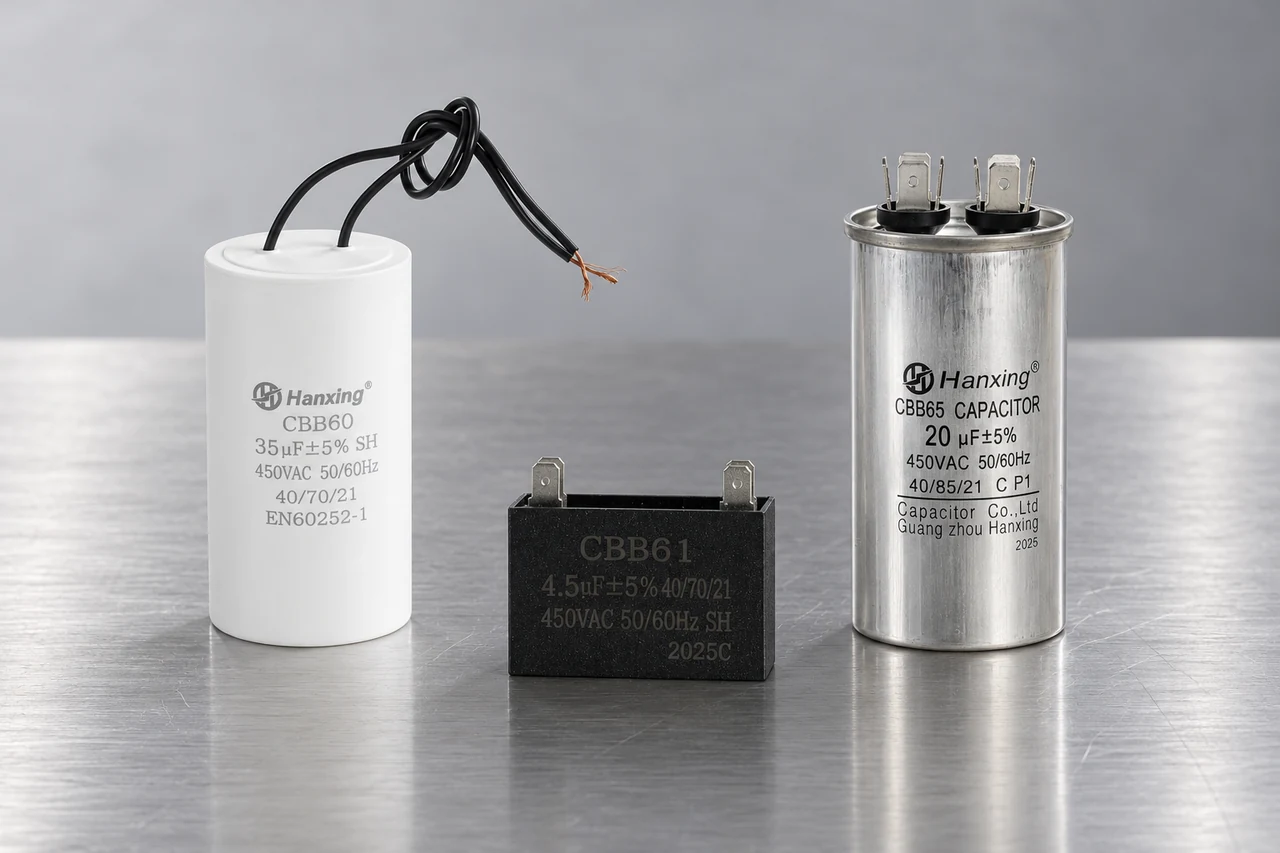
CBB60, CBB61 and CBB65 are film run-capacitor families in different case formats. CD60 is an electrolytic start-capacitor family for intermittent duty. Replacements across families need the motor’s approved electrical specification and a compatible installation; matching µF and VAC alone is insufficient.
Compare the formats by their intended role
The table summarizes HAN XING catalogue families. It is a selection overview, not a list of every available combination. A quoted model specifies its own tolerance, temperature category, dimensions and connections.
| Family | Construction and duty | Published capacitance range | Case format |
|---|---|---|---|
| CBB60 | Polypropylene film; run | 2–100 µF | Insulated cylinder |
| CBB61 | Polypropylene film; run | 0.5–35 µF | Insulated rectangle |
| CBB65 | Film; single or dual run | Single 2–100 µF; dual 1+15 to 15+80 µF | Metal can |
| CD60 | AC aluminium electrolytic; intermittent start | 20–1500 µF | Model-specific cylinder and terminals |
CBB60: leads and stud mounting
The upright and horizontal samples show the insulated leads and threaded base stud. Allow space for the stud and for the leads where they leave the case.
CBB61: similar housings, different ratings
The three CBB61 samples are marked 4.5 µF, 5 µF and 6 µF. Each is a separate capacitor with its own electrical rating.
CBB65: metal can and terminal groups
Two insulated terminal groups, each with several blades. Record groups and blades separately on the connection drawing.
CBB60 and CBB61 differ in assembly as well as shape
A rectangular CBB61 can suit a compact fan housing, while a cylindrical CBB60 can suit a pump bracket. That does not make either family exclusive to one appliance. A cross-family proposal needs the same required nominal capacitance, voltage, duty and operating conditions, followed by the full mounting and connection review.
Wire exits, mounting tabs, a base stud or blade terminals can make an electrically suitable alternative impractical to install. Keep the approved equipment drawing as the reference for those differences.
A metal can or dual value adds another selection question
A CBB65 dual-run model contains two capacitance sections and their assigned terminal connections. A single CBB60 with one matching value cannot replace that complete function. For a single-run comparison, the model’s protection, temperature and installation requirements still matter.
A CD60 comparison starts with duty. CBB60 and CBB65 remain in run circuits; CD60 is disconnected after starting. A CD60 with the same capacitance as a run part is therefore not an interchangeable construction.
Class markings belong to the model, not the family name
Safety classes S0–S3 and operation classes A–D describe separate characteristics. The operation class’s design-life figure depends on rated conditions. Do not assign a class or lifetime to every CBB65 or CBB60 from one sample label. Use the selected model documents for that requirement.
Compare the right configurations
Include the original motor requirement and the proposed family so the electrical and installation differences can be reviewed together.