
Choose an AC motor start capacitor with the motor’s specified capacitance and voltage, the required starting-duty limits and a compatible installation. CD60 uses an aluminium electrolytic construction intended for intermittent AC starting. A general-purpose polarized DC electrolytic is unsuitable for that circuit.
The 500 µF sample and the catalogue describe different scopes
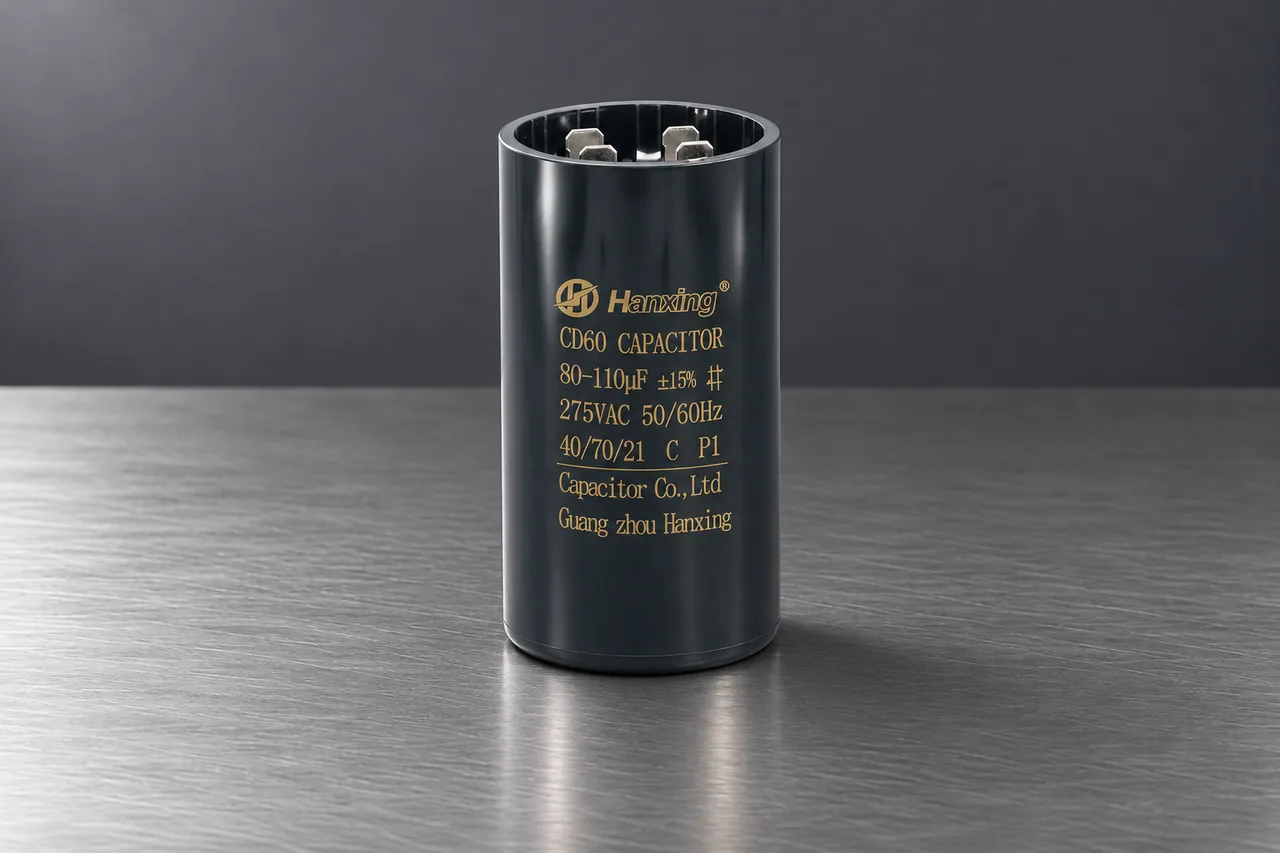
The photographed CD60 P038 sample reads 500 µF, 300 VAC, ±5% and 50/60 Hz, with a −40 °C / 70 °C / 21 marking. The catalogue lists a family range of 20–1500 µF, 110–330 VAC, ±10% or ±20%, and −20 to +65 °C. Keep those sources separate: the photographed sample does not extend every model’s temperature or tolerance rating.
Where the label and catalogue differ, use the exact model datasheet to settle the capacitance tolerance, operating temperature and intermittent-duty conditions. Maximum starting time is a separate model rating; it cannot be read from the CD60 name or a 300 VAC marking.
500 µF / 300 VAC start-capacitor sample
The visible label gives electrical markings but no on-time or repeat-start limit.
Keep voltage selection tied to starting duty
The motor documentation determines the starting capacitance or specified capacitance band. Preserve that requirement rather than increasing µF to compensate for difficult starts. The rated AC voltage must suit the capacitor’s circuit, and its duty rating must cover the starting sequence at that voltage and frequency.
A motor with both start and run capacitors needs each component kept in its assigned circuit. The start device’s disconnection and any specified discharge provision remain part of the replacement design. The CD60 cannot stay connected as a continuous-duty run capacitor.
Terminals, mounting and storage still affect the order
Blade terminals and wire leads need their own connection drawing. Specify the case dimensions, bracket or other fixing, and the clearance around the fitted connector. A photograph helps identify the arrangement, but it does not supply dimensional tolerances or an approved terminal assignment.
For stock held before assembly, obtain the model’s storage conditions and shelf-life instructions. Another manufacturer’s shelf-life or endurance figure is not a CD60 guarantee. Acceptance testing also needs the start-capacitor method and model limits; a test regime intended for a different construction cannot be copied without review.
Get a CD60 replacement proposal
Include the original label, motor reference, starting pattern and the connection and mounting dimensions.