
Safety classes describe protection in a capacitor failure; operation classes describe probable design life under rated conditions. They are separate classifications. Specify the required class, standard edition and operating conditions for the exact model rather than assigning a class to a whole capacitor family.
What S0, S1, S2 and S3 describe
IEC 60252-1 addresses AC motor capacitor ratings, performance, testing and safety within its stated scope. IEC 60252-2 separately addresses motor start capacitors. Use the edition required by the equipment and the model’s supporting documents. TDK’s published overview summarizes the safety categories below. IEC 60252-1: AC motor capacitors TDK: capacitor safety and operation classes
| Class | Failure protection |
|---|---|
| S0 (P0) | No specific failure protection. |
| S1 (P1) | Open or short-circuit failure is possible, with protection against fire or shock hazards. |
| S2 (P2) | Designed to fail open circuit, with protection against fire or shock hazards. |
| S3 | Segmented-film protection with low residual capacitance on failure and protection against fire and shock hazards. |
A life class needs its rated conditions
TDK summarizes operation classes A, B, C and D as 30,000, 10,000, 3,000 and 1,000 hours respectively under rated conditions. These figures are design-life classifications, not a forecast of one component’s service interval or a warranty for every installation.
The same TDK B32350/B32352 datasheet lists Class A at 400 VAC and Class B at 450 VAC, with safety class S3 stated separately. That example shows why a class must stay attached to voltage and operating conditions. Those ratings belong to the TDK models in that document, not to HAN XING products. TDK: climatic category and operating conditions
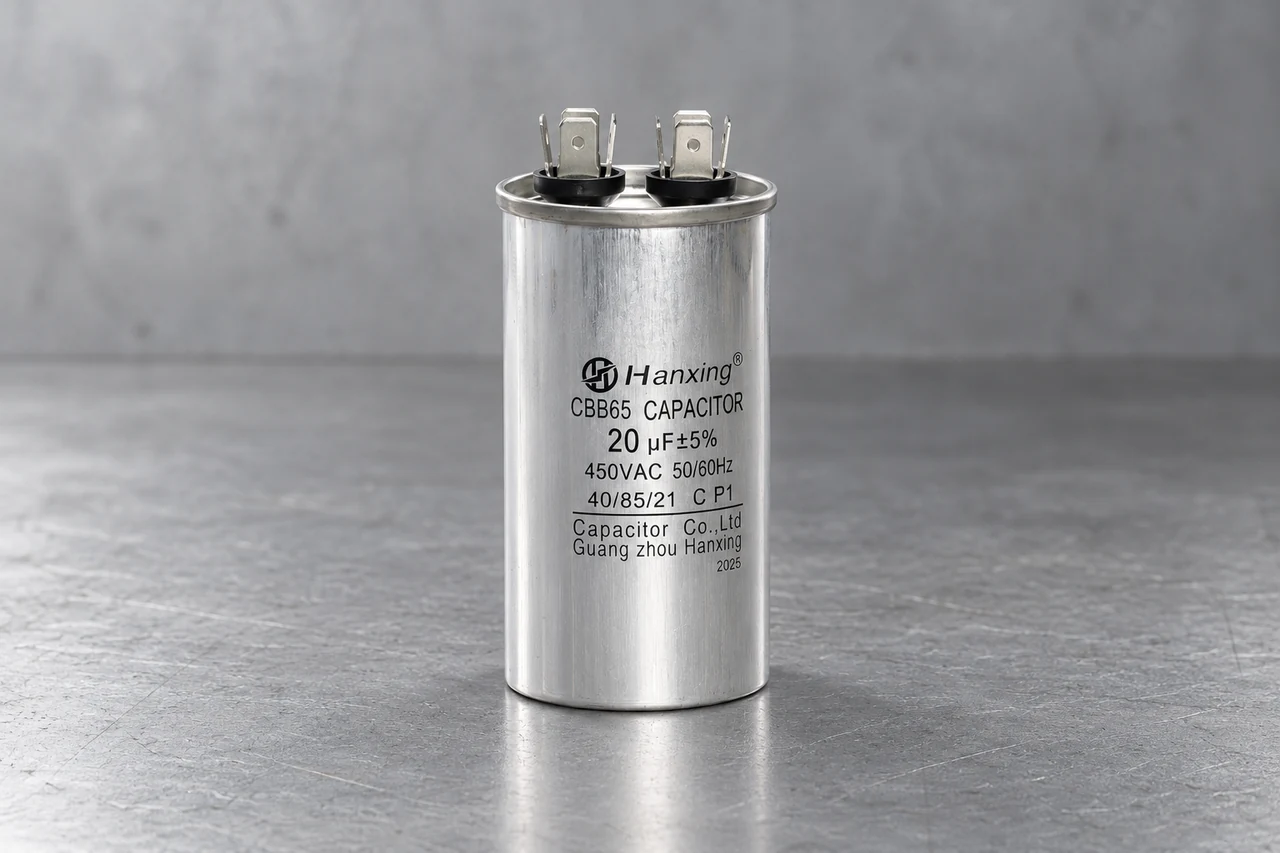
Read C and P1 on the original CBB65 label
The supplied CBB65 label reads 40/85/21 C P1. The climatic code, operation class C and older protection marking P1 concern separate requirements. The selected model datasheet and its supporting report establish the standard edition and rated conditions behind those markings.
Installation still follows the model instructions. A protection mechanism can need clearance or freedom to operate, and its presence does not authorize a different voltage or duty. Include any required bracket, terminal clearance and operating environment in the purchase specification.
C and P1 on an original CBB65 label
The model documents give the conditions and scope behind the markings.
State which evidence the order needs
Routine tests, type tests and endurance tests have different scopes. A claimed class needs evidence for the quoted design and ratings; a routine capacitance result alone does not establish an endurance classification. Where certification is required, the issuer, model coverage and standard edition must also match.
Specify the class required by your equipment
Include the standard edition, required safety and operation classes, rated conditions and certificate scope.