
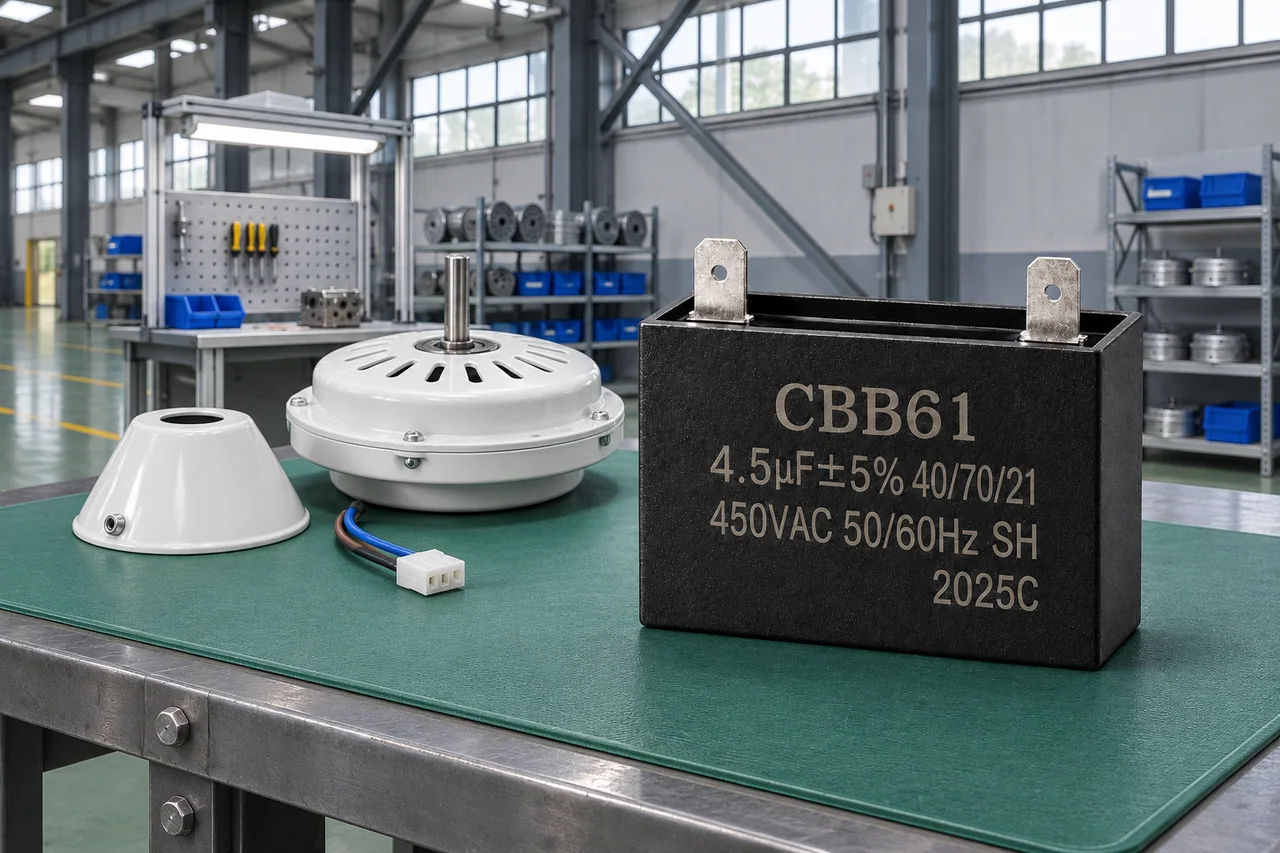
Use the fan motor’s specified µF and AC voltage rating. There is no universal capacitance calculator based only on fan diameter, speed or motor power. The motor circuit also determines whether it uses a permanent run capacitor, a switched start component or electronic control.
Ceiling fans and industrial blowers need different records
A ceiling fan, table fan, stand fan, axial extractor, cross-flow fan or range-hood motor can use a capacitor-run design, but these names do not specify a common capacitor. A centrifugal blower can use a different case format from a compact ceiling-fan assembly. The motor model and circuit settle that choice.
In a permanent split capacitor motor, the run capacitor serves the auxiliary winding during starting and running. Electronically controlled fan motors need their own component schedule. A condenser fan in HVAC equipment also needs its assigned value kept separate from the compressor’s value, even when both sections share a dual-run can.
Keep the motor’s µF value through the replacement
A larger capacitor changes the current in the auxiliary winding and can affect heating and torque. It is not a general speed upgrade. Keep the required nominal µF, tolerance and frequency with the replacement specification. A 50/60 Hz marking on a capacitor is useful only when the motor and the proposed duty also suit the intended supply frequency.
For a fan operating near a hot motor or inside a closed housing, the selected capacitor’s temperature category matters. The family name alone does not supply that limit. Material and test requirements, including insulation resistance, dissipation factor and voltage withstand, need their own model data and acceptance conditions.
Choose the harness for the fan model
A fan-speed capacitor assembly can contain several sections with a shared connection. Two parts with the same number of wires can have different internal arrangements. Wire colors, blade positions and a similar rectangular shell cannot replace the fan’s wiring diagram.
Wire leads suit a routed harness; blade terminals suit a defined mating plug. Case dimensions, mounting tabs and clearance with the cover closed determine the fit. The CBB61 connection guide explains how to specify the lead length, mating connector and mounting geometry.
When the fan is slow or will not start
Capacitance loss is one possible fault. Supply problems, poor connections and mechanical drag also deserve diagnosis. A qualified technician can measure capacitance after safe isolation and compare the reading with the marked tolerance; that measurement does not replace insulation or dielectric testing when those are required.
Source the capacitor for your fan range
Group the required ratings and harness drawings by fan model so each version has its own quoted configuration.